Key highlights
- High-quality product data is now a prerequisite for visibility, performance, and trust across every commerce channel.
- Data enrichment fills critical gaps in product attributes, content, and structure so products can perform consistently at scale.
- Feedonomics Data Enrichment helps brands operationalize enrichment across channels without adding complexity.
- AI-powered enrichment reduces the manual burden on marketing and ecommerce teams while improving speed and accuracy.
- Enriched product data supports everything from marketplace readiness to SEO and emerging AI-powered search experiences.
Commerce teams are under pressure from every direction.
More channels. More formats. More rules.
At the same time, shoppers and algorithms expect richer, more accurate product content everywhere products appear. Marketplaces demand structured attributes. Ad platforms reward relevance. AI-powered search engines look for depth, context, and consistency.
This puts an enormous strain on marketing, ecommerce, and operations teams. Manually enriching thousands or millions of SKUs simply doesn’t scale.
That’s why data enrichment has moved from a “nice to have” to a core go-to-market capability.
Feedonomics Data Enrichment is built to solve challenges on specific channels, fill in content gaps, make multi-language feeds a reality, and elevate the quality of your product data everywhere. In the age of AI-driven discovery, that consistency means there’s no guesswork about the value your products can offer.
What is data enrichment, and why does it matter now?
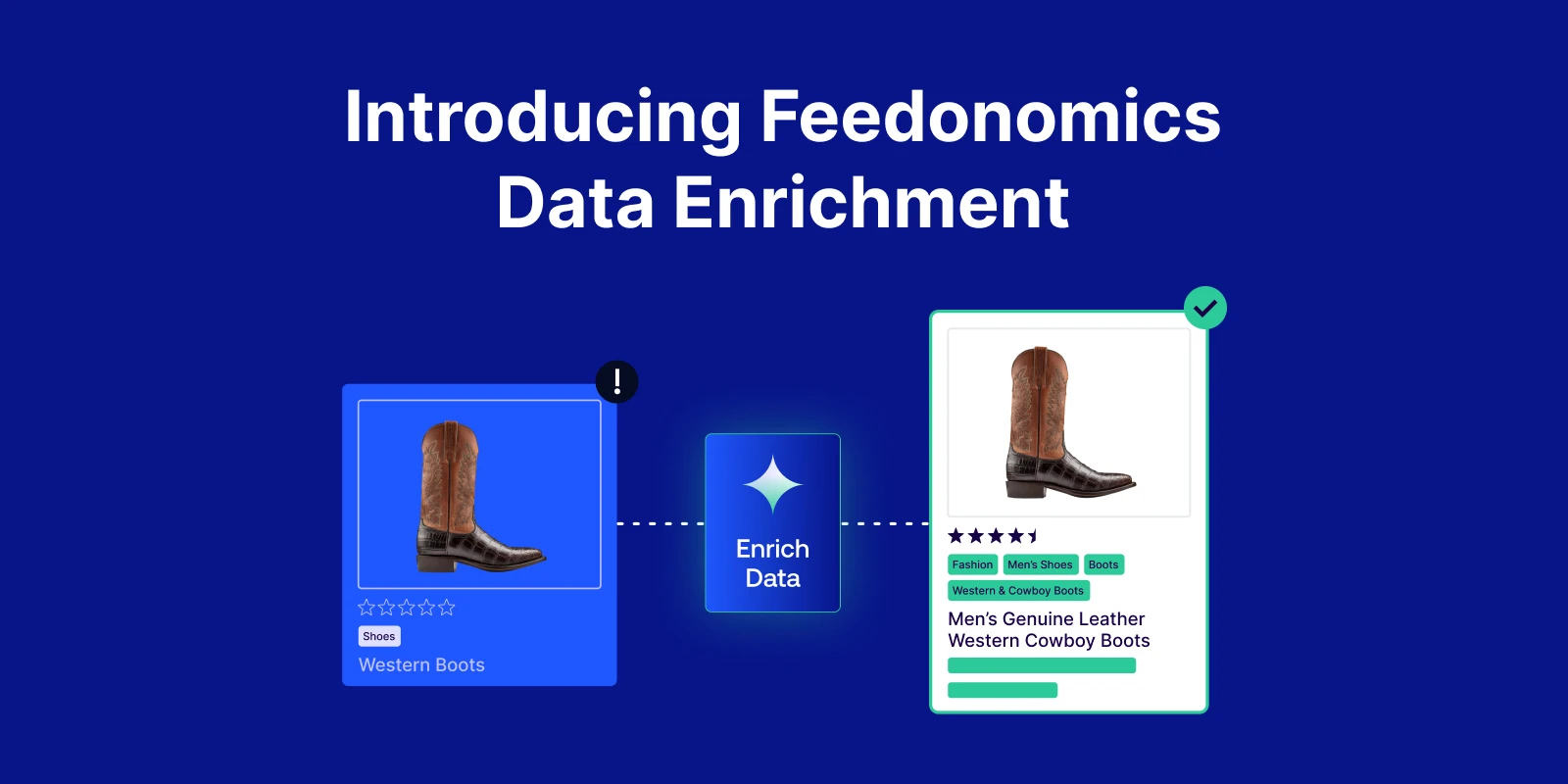
Data enrichment is the process of enhancing raw product data with additional attributes, structured fields, and optimized content so products can perform across every channel.
At a basic level, enrichment fills in missing information. At a strategic level, it transforms product data into a growth asset.
Several forces are accelerating its importance:
- Channel proliferation: Each marketplace, ad platform, and commerce surface has its own data requirements.
- Rising content standards: Thin or incomplete listings are suppressed by both marketplaces and search engines.
- AI-driven discovery: Large language models and answer engines rely on structured, high-quality data to surface products accurately.
- Operational scale: Catalogs are growing faster than teams can manually manage.
Feedonomics sees enrichment as part of a broader data maturity journey — moving brands from basic product visibility to fully contextualized, brand-rich catalogs that support modern commerce experiences.
Data enrichment isn’t about adding more content. It’s about adding the right content, in the right structure, everywhere it’s needed.
Feedonomics Data Enrichment use cases
| Branded copy generation | Elevate brand storytelling, improve search visibility, and drive higher engagement without manual copywriting effort. |
| Attribute and taxonomy completion | Deliver consistent, searchable product data that improves accuracy across every system and channel. |
| Channel-specific optimization | Reach more shoppers and convert faster with AI-optimized content purpose-built for each platform’s search and merchandising rules. |
| SEO and metadata enrichment | Drive more organic traffic, improve ad performance, and ensure your brand appears where shoppers are searching. |
| Answer Engine Optimization (AEO) | Ensure your products surface in AI-powered search experiences like Perplexity, Copilot, and ChatGPT, shaping how shoppers discover and trust your brand. |
Enhance your catalog with data enrichment.
The challenges teams face without scalable enrichment
Without scalable enrichment, teams try to squeeze performance out of catalogs that have significant gaps and lack structure or consistency, or they spend way too much time and effort fixing everything. This slows down their ability to go to market quickly and hit goals.
1. Incomplete and inconsistent product data
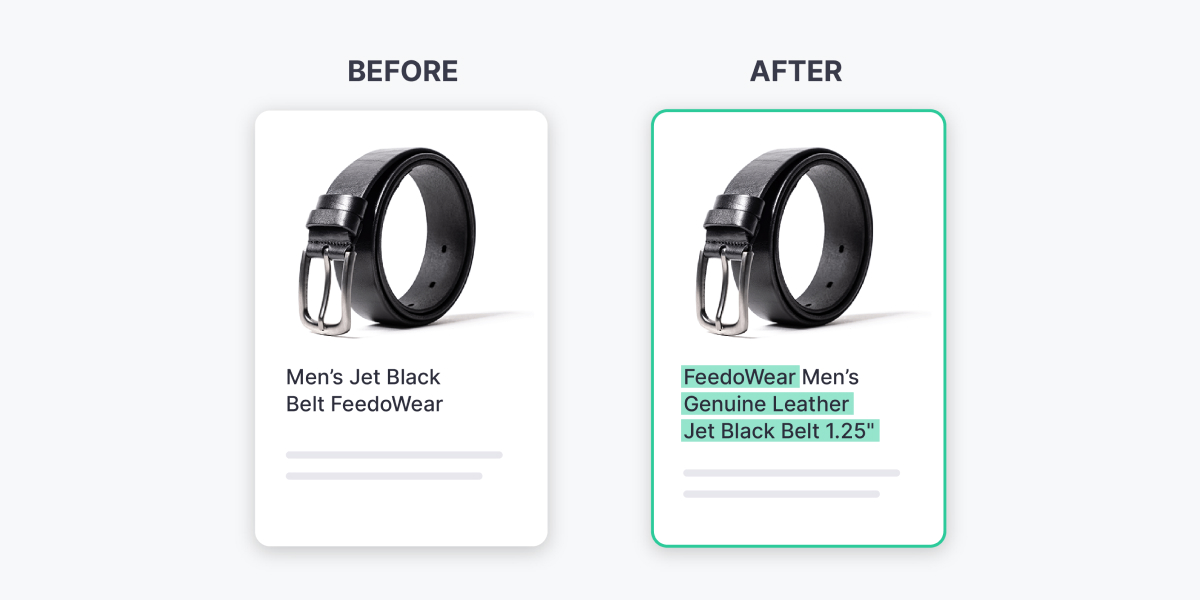
Raw catalogs often arrive fragmented. Attributes are missing, misformatted, or inconsistent across systems.
When critical product attributes are incomplete or inconsistent, discovery and performance suffer across channels. Search engines, marketplaces, and AI-driven discovery systems rely on structured attributes to determine relevance, ranking, and eligibility. Gaps in material, size, compatibility, or use case reduce visibility in filters, limit placement opportunities, and weaken the signals used to match products to shopper intent.
Over time, fragmented product data also creates operational drag. Teams spend cycles troubleshooting disapprovals, rebuilding feeds for new channels, or manually correcting errors that scale poorly as catalogs grow. As channels become more automated and data-driven, missing or inconsistent attributes translate directly into slower launches, uneven performance, and missed revenue opportunities.
Example: A product has a title and price but lacks material, size, or use-case attributes required by marketplaces or filters.
What sellers can do:
- Audit catalog completeness by channel requirements
- Standardize attribute naming and formatting
- Prioritize high-impact attributes first
How Feedonomics helps:
Feedonomics automates attribute completion and normalization so products meet channel standards without manual cleanup.
2. Marketing teams overloaded with manual content creation
Creating titles, descriptions, bullets, metadata, and translations often require manual effort or a tedious process that’s multiplied by every channel. Even if the manual effort is reduced, finding a bulk method of generating content that’s optimized and brand-rich can require sacrifices in visibility or control.
This work often falls on already-stretched marketing teams.
Example: A marketer manually rewrites product descriptions for Amazon, Google, and the website — SKU by SKU.
What sellers can do:
- Identify repeatable content patterns
- Separate brand voice rules from execution
- Automate wherever possible
How Feedonomics helps:
Feedonomics uses AI-powered branded copy generation and automation to scale product content, while maintaining brand voice and consistency.
3. Products underperforming on key channels
Even strong products struggle if data isn’t optimized for each platform’s rules.
Example: A product ranks well on-site but underperforms on marketplaces due to missing bullets or incorrect taxonomy.
What sellers can do:
- Align product data to channel-specific requirements
- Optimize titles, bullets, and attributes per platform
- Monitor performance signals tied to data quality
How Feedonomics helps:
Feedonomics generates channel-specific optimizations so each product is ready to perform wherever it’s listed.
How data enrichment powers modern go-to-market strategies
Enrichment as a foundation for omnichannel growth
Enrichment is a go-to-market accelerator. When product data is enriched once and structured correctly, teams gain the ability to activate products across channels without introducing delays, rework, or inconsistencies. Marketing, ecommerce, and marketplace teams can move in parallel instead of waiting on manual updates or one-off fixes.
As channel ecosystems continue to fragment and evolve, enrichment becomes the connective tissue between strategy and execution. It allows brands to respond quickly to new channel requirements, test and optimize performance at scale, and support emerging use cases like AI-driven optimization and automation.
High-quality enrichment ensures products are:
- Searchable: Complete attributes improve filtering, relevance, and discovery
- Shoppable: Clear descriptions and specs reduce friction
- Scalable: New channels don’t require starting from scratch
This foundation supports faster launches and more consistent performance across marketplaces, paid media, and owned channels.
Reducing operational load with AI-powered enrichment
Manual enrichment doesn’t scale, especially as catalogs grow and channels are added.
AI-driven enrichment allows teams to:
- Generate branded titles and descriptions automatically
- Complete attribute taxonomies across large catalogs
- Apply SEO and metadata enhancements consistently
- Localize and create multi-language content efficiently
The result is higher-quality data with less hands-on effort from marketers and merchandisers.
Preparing product data for AI-powered discovery
Search is evolving. More than 60% of consumers have used conversational AI tools like ChatGPT or Gemini to help them shop online, and over half say their search habits have become more conversational over the past year.
As search shifts from keyword-based queries to intent-driven experiences, the quality and structure of product data becomes a competitive differentiator. AI-powered discovery surfaces products because the data clearly communicates what a product is, who it is for, and how it should be used. Enrichment provides the clarity and consistency these systems require to interpret and recommend products with confidence.
Looking ahead, brands that treat enrichment as a foundational capability gain the ability to adapt as new answer engines, shopping assistants, and agentic experiences emerge. By investing in context-rich product data today, organizations strengthen long-term visibility and relevance, ensuring their products remain discoverable as the mechanics of search evolve beyond keywords and links.
Answer engines, conversational commerce, and AI shopping assistants rely on structured, context-rich product data.
Enrichment supports:
- SEO and metadata optimization for traditional search
- Answer Engine Optimization (AEO) for AI-driven discovery
- Contextual signals that help models understand product use, fit, and value
This positions brands to stay visible as discovery moves beyond keywords.
The final word
Data enrichment has become a strategic necessity that’s fundamental to success for marketers.
As channels multiply and discovery becomes more AI-driven, brands need product data that is complete, consistent, and optimized everywhere it appears. Doing this manually is no longer realistic.
By automating enrichment at scale, ecommerce teams reduce the burden on marketers, improve speed to market, and unlock stronger performance across channels.
See how Feedonomics helps sellers enrich product data for the AI era.
Scalable data enrichment is within reach.
FAQs
What types of product data can be enriched?
Data enrichment can include titles, descriptions, attributes, taxonomy, SEO metadata, channel-specific fields, and structured content for AI search experiences.
How does data enrichment reduce manual work for teams?
Automation handles repetitive content creation and attribute completion, allowing marketers to focus on strategy instead of SKU-level tasks.
Is data enrichment only for marketplaces?
No. Enrichment supports websites, advertising platforms, marketplaces, internal systems, and emerging AI-powered discovery channels.
How does data enrichment impact SEO?
Richer, more structured product data improves relevance, metadata quality, and discoverability across search engines and ad platforms.
When should brands invest in data enrichment?
As soon as catalogs grow beyond what teams can manage manually — especially when expanding into new channels or regions.

Mario is a senior content marketing manager based in Texas. He enjoys solving problems, learning about new ecommerce tech, and breaking down complex topics into useful tips for readers.