


Why Your Catalog Is Your Most Important Salesperson in the Age of AI

Written by
Anita J. Temple

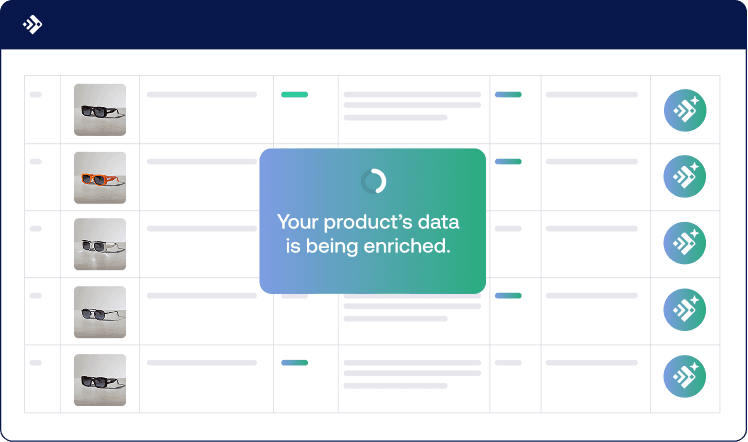
Optimize thousands of products automatically with AI enrichment
Feedonomics Surface
Install on BigCommerce — free and ready in minutes.
Your stack, upgraded.
Connect the dots so your systems move like one engine.

Blog

Guides, Reports, & Whitepapers

Webinars

Press Releases
AI isn’t assisting discovery. It’s rewriting it.
Explore how AI is reshaping shopper behavior — and what brands must do to stay visible.
Written by
Optimize thousands of products automatically with AI enrichment
The funnel is shrinking. Agentic commerce has compressed the traditional four-step funnel to just two: intent and transaction — and it's happening now.
Invisible data, invisible brand. If your product catalog isn't structured and enriched for the schemas AI agents are reading, your products simply won't be found.
AI-ready means attribute-ready. Consistent structure, explicit attributes, and a clear source of truth are what separate discoverable products from ones that get skipped.
Start small, scale fast. You don't need perfect data to get started — focus on your top-performing products first, enrich them, and build from there.
Discovery without purchase is just advertising. Getting into AI surfaces matters, but closing the transaction in the same environment is what turns discoverability into revenue.
For years, the product feed was a back-office function. You built your storefront, drove traffic to it, and somewhere in the background, a feed kept your product data flowing to Google Shopping and a handful of ad channels. It was infrastructure. Important, certainly, but not exactly the thing people gathered in Chicago to talk about.
That changed at Commerce Live 2026.
Over the course of two and a half days at Chicago’s Navy Pier, speaker after speaker — analysts, practitioners, futurists, and operators from some of the world's largest brands — arrived at the same conclusion from different directions: in a world where AI agents are increasingly deciding what gets recommended, what gets found, and what gets purchased, your product catalog isn't just a data asset. It's the primary way your brand shows up in the world.
Feedonomics sits at the center of that shift. As Commerce's product intelligence layer, it's what makes brands discoverable across every surface where shoppers are now finding and buying products — from established ad channels and marketplaces to the AI answer engines and agentic checkout experiences rewriting how commerce works.
At Commerce Live, customers didn't just acknowledge that role. They named it. Practitioners from Tapestry, Belk, Pickleball Central, and Oldcastle all called out Feedonomics specifically as a critical partner in their data readiness and discoverability strategies. And Commerce made clear that investment in the product isn't slowing down — with a wave of new Feedonomics capabilities announced at the event, from AI-powered catalog enrichment to agentic catalog exports and checkout integrations, all designed to meet customers where they are today and where commerce is heading next.
Here's what we heard.
Sharon Gee, Vice President of Product, AI & Feedonomics at Commerce, put the conversation in motion during the product keynote: “The traditional funnel had four steps: awareness, consideration, evaluation, purchase. And increasingly, agentic commerce has two: intent and transaction.”
That compression isn't a future prediction. It's happening now, and it's being felt. Brands are noticing organic search traffic shifting. Shoppers are asking AI engines for recommendations and acting on them without ever visiting a website. The middle of the funnel — the research, the comparison, the consideration — is being absorbed by AI surfaces that make decisions on shoppers' behalf.

Discovery no longer starts with Google: Commerce is compressing, making product data feed optimization more critical than ever.
For brands, this creates an urgent question: if a shopper never lands on your website, how do you make sure your products still get found, evaluated, and purchased?
The answer, consistently, was product data.
No less than three speakers used the word invisible to describe disparate data. Heather Hershey, Research Director at IDC, was characteristically blunt: “If your product data isn't structured and enriched for the schemas AI agents are reading, you're invisible. It's that simple.”
She wasn't speaking theoretically. Hershey, who interviews hundreds of vendors and buyers each year across the commerce ecosystem, described product data as “the spine of commerce” — the one constant across every channel shift she's witnessed, from the rise of search to social commerce to marketplaces, and now into agentic.
Gee echoed her thoughts.
“What makes this shift different from every other channel shift we've seen from ads, to social commerce, to marketplaces, and now into agentic, is that AI doesn't ask your permission to present your information, to answer that user's query. It reads your data and it decides. If your catalog isn't in the mind of the agent, you're invisible.”
— Sharon Gee, VP, AI & Feedonomics, Commerce
In a fireside chat with Michaela Weber, VP of Product, Payments at Commerce, Mike Edmonds, VP of Agentic for Commercial Growth at PayPal, made the same point from a payments and discoverability angle: “Discoverability is the most critical layer of agentic commerce right now. If your product catalog is not being pulled into how these recommendations are happening, you are effectively invisible to agent commerce at the most important layer.”
His prescription was unambiguous: “Number one, it starts with your product catalog. Having your catalog enriched and optimized in a way where you show up when people are asking, not searching. That's absolutely critical.” It's precisely the capability Feedonomics has been building and refining for over a decade — and the reason practitioners at Commerce Live were already putting it to work.
The practitioners in the room weren't speaking in abstractions. Darlene Bui, Senior Analyst for Feeds at Tapestry, the parent company of Coach, Kate Spade, and Stuart Weitzman, brought a ground-level view of what AI-ready product data looks like in practice. Tapestry has been working with Feedonomics to enrich and syndicate product data across channels, and Bui's perspective reflected that hands-on experience.
“AI-ready data is when every product has consistent structure and explicit attributes — pricing, features, use case — so that AI can deliver accurate and relevant discovery. It often breaks when the details are inconsistent, unstructured, and lack a clear source of truth.”
— Darlene Bui, Senior Analyst, Feeds, Tapestry
Her colleague Laura Leung, Product Manager for Digital and Ecommerce at Tapestry, described how they approach the challenge of maintaining brand distinctiveness across multiple labels while building on a shared data foundation: “At the foundation it's all the same — clean, consistent, AI-ready — and then we layer in what makes each brand distinct on top of that.”
Bui offered a concrete example of what enriched, attributed data unlocks in practice. The team had started tagging for trend attributes — for example, “plaid” — that hadn't previously been captured in their product data. “It had a major impact on our site search and on how our products ranked externally.” A single missing attribute, once added at scale, moved the needle measurably.
Her first piece of advice for anyone starting their AI readiness journey: “Take your top products and convert their key details from unstructured descriptions to structured attributes.” Not a multi-year transformation program. A focused, high-impact starting point.
One of the most consistent themes across Commerce Live was a reframe that's easy to say but harder to internalize: the data problem most organizations are staring at isn't a blocker. It's where the opportunity lives.
Rajesh Mohan, Senior Director of Digital Commerce and Customer Experience at Oldcastle - CRH Americas Building Products, — one of the largest building products manufacturers in North America, and a Feedonomics customer — put it simply: “Every organization has actionable data right now. The goal is to find it, understand what use case it supports, and assess whether it's structured, trusted, and usable. If you wait for perfect data, you’ll never be able to get off the ground.”
He described a mindset shift that had worked for his team: stop treating data as an IT infrastructure project and start treating it as a business capability.
“Data is an opportunity. Find the opportunities the use cases support. Start there. Be successful. Scale.”
— Rajesh (Raj) Mohan, Sr. Director, Digital Commerce & Customer Experience, Oldcastle - CRH Americas Building Products
Traver West, VP of Ecommerce at Pickleball Central, echoed this from the operator perspective, and was direct about the role Feedonomics plays in turning enriched data into channel presence.
“The goal isn't to fix all your data at once. It's to start with your top-performing products, understand how your customers are actually searching for them — including the language they're using today, not three years ago — and make sure that language lives in your product data and flows to every surface where shoppers are looking.”
— Traver West, VP of Ecommerce, Pickleball Central
“Whatever LLM or search engine or smoke signal people are using to find products like ours,” he said, “we're massaging and enhancing the data associated with all of our best top-selling products to ensure we're there.” West credited Feedonomics as a key partner in ensuring that enriched data reaches the right channels: “Feedonomics has been a tremendous partner in ensuring that all of the data that we're spending so much time enhancing within the back end of our store is distributed to all the right channels.”
Ashlyn Caporicci, Strategic Sourcing Lead at Belk, offered a look at what cross-functional data enrichment actually requires inside a large organization. Belk is currently mid-way through a Feedonomics data enrichment project, and getting it off the ground meant aligning marketing, IT, ecommerce, and eventually customer care across multiple rounds of requirements gathering and stakeholder alignment. “It doesn't just live with your data architect. There's a lot of information in people's heads that needs to not be only in people's heads.”
Feedonomics has always been about making product data work harder across more surfaces — normalizing it, enriching it, and routing it to wherever shoppers are. What Commerce Live made clear is that the set of surfaces has expanded significantly, and the requirements for each one have become both more specific and more consequential.
Every AI discovery surface has different requirements: different protocols, different fields, different ingestion methods. Google AI surfaces require Universal Commerce Protocol. OpenAI has a different specification. Perplexity, Copilot, PayPal, and Amazon Shop Direct each have their own. And the landscape is changing weekly.
Merchants shouldn't have to build a custom integration every time a new surface appears. The new Feedonomics Agentic Catalog Exports capability handles that distribution layer — taking an enriched catalog and optimizing it for the destination schema, whatever that schema happens to be today, and whatever it becomes tomorrow. It's a direct extension of what Feedonomics has always done, applied to the fastest-evolving distribution landscape in commerce history.

Feedonomics’ Agentic Catalog Exports makes your data more discoverable.
The launch of PayPal StoreSync, announced at Commerce Live, makes the connection between enrichment and purchase concrete. BigCommerce customers who install the app have their catalog syndicated through PayPal to Perplexity, Copilot, Meta, and — via Universal Commerce Protocol — Google. A shopper places an order inside one of those AI surfaces. The order routes directly back into BigCommerce. Discovery happens in the agent's environment. Fulfillment runs through the merchant's system. The customer relationship stays with the brand.
For merchants not on BigCommerce, the Feedonomics Agentic Checkout Kit creates the same bridge: connecting catalog, inventory, payments, shipping, tax, and orders between any agentic surface and a merchant's existing commerce stack. PacSun, highlighted at Commerce Live, is live on this infrastructure — their products discoverable and purchasable across agentic channels without requiring a full platform migration.
One of the more memorable lines from the PayPal session came from Edmonds: “Discovery without purchase is just advertising.”
The point behind his statement is important. Getting your catalog in front of AI agents is necessary but not sufficient. The transaction has to be able to close in the same surface where discovery happened. And making that work requires solving a set of problems that are genuinely new — fraud protection, identity verification, and chargeback handling in an environment where the buyer may be an agent acting on a human's behalf.
Edmonds framed this as a trust architecture problem.
“In the era of traditional ecommerce, we built trust by knowing your business and knowing your consumer and making sure both actors had a trusted relationship before a transaction could occur. That same paradigm applies in agentic commerce. We're just adding another actor: agents. Now it's,know your agent.”
— Mike Edmonds, VP of Agentic for Commercial Growth at PayPal
The implication for merchants is that the payment infrastructure choices made now will determine readiness for a delegation economy that Edmonds placed 18 to 24 months out. A world where shoppers equip agents with spending parameters and preferred payment methods, and the agents complete purchases without a human pressing a button.
For brands that have enriched their catalogs, syndicated to agentic surfaces, and connected the transaction layer: that world is ready for them. For brands that haven't started: the window to build a learning advantage is narrowing.
Multiple speakers referenced a concept that's gaining traction rapidly in commerce circles: Answer Engine Optimization, or AEO. It's the recognition that the optimization discipline that drove a decade of SEO investment needs to evolve for a world where AI answer engines, not search engines, are increasingly the first point of contact between a shopper and a product.
Hershey from IDC was specific about what AEO requires that SEO didn't: "Answer engines are not reading your product catalogs. What they want is to find solutions for informational intent queries — which means you have to put mini FAQs on your PDPs so that agents have something to work with when they are generating answers to informational intent queries."
The search box, as Michael Scholz, VP of Product & Customer Marketing at Commerce put it during one of the breakout sessions, is becoming the intent box.
“A shopper who types ‘What suit should I wear to a summer wedding in New York in August?’ into an AI engine isn't searching for a product. They're asking for a recommendation. Brands whose product data can answer that question, whose catalogs contain the contextual, conversational attributes that map to how humans actually ask, will show up.”
— Michael Scholz, VP of Product & Customer Marketing, Commerce
Brands whose data consists of SKUs, dimensions, and marketing copy written for humans skimming a product page will not. Feedonomics Data Enrichment addresses exactly this gap, generating the rich, structured, brand-accurate product data that LLMs need to find, recommend, and transact on a brand's behalf.
Commerce Live wasn't just a conference about where things are going. It was a conference where brands already in motion shared what they'd learned.
Tapestry is actively enriching product attributes for AI discoverability and has seen measurable improvements in site search performance and external channel ranking as a result. Oldcastle has undergone a year-long data cleanse initiative and is running proof-of-concept agentic experiences in parallel. Belk is mid-way through a Feedonomics data enrichment project that required cross-functional alignment across five departments. Pickleball Central is actively updating product descriptions to include the language customers are using in LLM queries — what West called “TikTok terms” — and using Feedonomics to ensure that enriched data reaches every channel where their customers are searching.
These aren't edge cases. They're operators running real businesses at real scale, making the same set of investments in product data because the business case has become clear: visibility in AI surfaces is now a competitive advantage, and the brands who act now will be harder to displace later.
Multiple practitioners were asked the same question across different sessions: if you were starting your AI data readiness journey on Monday, what's the one thing you'd do first? Their answers, synthesized, point to three concrete starting points.
Audit your top products first. Don't try to fix everything at once. Identify your top 5 to 10% of products by revenue and start there. Convert unstructured descriptions into structured, explicit attributes. Make sure those products show up correctly when you ask an AI engine to recommend them. Feedonomics Enrichment can accelerate this process at scale, applying GenAI to produce structured, brand-accurate attributes across large catalogs without requiring a manual rewrite of every product.
See for yourself if the AI engines can find you. Open ChatGPT, Gemini, or Claude. Put your customer hat on. Ask high-intent questions about the products or solutions you sell. See what comes back. Then ask why it recommended what it did. The answer will tell you exactly where your data gaps are — and which competitors have already closed them.
Treat data enrichment as a continuous operation, not a project. Multiple practitioners made this point directly. The data problem doesn't have an end date. Customer language evolves, new attributes become relevant, AI surface schemas change. The brands that will win in this new agentic world won’t be the ones who do a data enrichment sprint, they'll be the ones building ongoing enrichment into their operations. That's the model Feedonomics is built for: not a one-time fix, but a continuous layer of intelligence between your catalog and every surface where your customers are looking.
The biggest takeaway from the data conversation at Commerce Live is that the window to gain a discoverability advantage in AI surfaces is open right now — but it won't stay open forever. The brands that invest in structured, enriched, agent-ready product data today are building a compounding asset. Every enrichment cycle makes their catalog more readable to more agents across more surfaces. Every new protocol that emerges is one more surface they're already positioned to be discovered on.
Your catalog has always been important. It's never been more important than it is right now.
To gain more insights on the future of commerce, explore all the Commerce Live 2026 content at: https://www.commerce.com/events/commerce-live-2026-recap/
Insights in this post were drawn from sessions at Commerce Live 2026, including the product keynote “Commerce Momentum: Product Vision & Roadmap for What's Next”; “Navigating the Future of Payments and AI” featuring Mike Edmonds (PayPal); the IDC keynote with Heather Hershey; and breakout sessions featuring practitioners from Tapestry, Old Castle, Belk, and Pickleball Central.
Anita J. Temple
Head of Content at BigCommerce