A few years ago, the battle for product discovery was fought on search engine results pages and marketplace listings.
Today, a growing share of that battle is happening somewhere new: inside the conversation a shopper has with an AI assistant.
When someone asks ChatGPT to recommend a laptop for video editing, or asks an AI assistant to find the right brake pads for their car, the agent doesn't browse the way a human does. It reads structured product data, evaluates attributes, and assembles an answer. If your catalog isn't built for that kind of reading, your products simply may not make the shortlist, no matter how good they are.
That's the gap that agentic catalog exports are designed to close.
Optimize thousands of products automatically with AI enrichment
Rethinking the traditional sales funnel
The middle of the funnel — exploration, comparison, narrowing down — is increasingly happening inside chat interfaces. AI-powered tools are replacing traditional search as the starting point of a shopping journey entirely.
That was one of the clearest takeaways from Shoptalk Spring 2026, where session after session reinforced a simple message to retail leaders: the conversation has moved past whether AI will change discovery, and onto how fast you can adapt to it.
At Commerce Live 2026, Sharon Gee, Senior Vice President of Product for AI at Commerce, put the structural shift bluntly:
“The traditional funnel had four steps: awareness, consideration, evaluation, purchase. And, increasingly, agentic commerce has two: intent and transaction.”
— Sharon Gee, SVP Product, AI, Commerce
That’s why being found is more important than ever, and that starts with your product data.
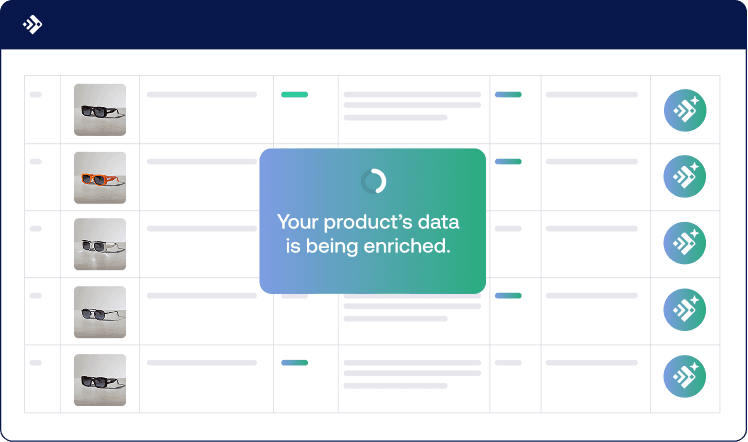
“If an agent can't parse your catalog, it will never surface your products,” Gee told the audience to set the stage for Feedonomics Data Enrichment. How it works: A generative AI service that produces rich, structured, brand-accurate product data at scale (i.e., the kind LLMs need to find, recommend, and buy from a merchant). Merchants pick what product data to enrich, add brand and SEO terms, and run jobs with an LLM-as-judge check and human review to stay on-brand and in control before launch.
This is where agentic catalog exports enter the picture.
What are agentic catalog exports, and why do they matter now?
An agentic catalog export is your product catalog packaged specifically for AI agents and AI-powered shopping experiences to consume. Instead of optimizing only for human eyes or for a single channel's feed spec, agentic exports prioritize the completeness, structure, and accuracy that large language models rely on to understand what a product is, who it's for, and when to recommend it.
This matters now because the entry point to product discovery is shifting. AI assistants are increasingly the first place shoppers go to research, compare, and narrow their options. These agents don't reward the brand with the biggest ad budget; they reward the catalog they can understand most completely. Missing attributes, vague descriptions, inconsistent taxonomy, or unstructured content all create ambiguity, and ambiguity gets your product passed over.
Supporting this shift is Feedonomics Agentic Catalog Exports, handling the distribution layer, and taking the enriched catalog and exporting it to the specific schema each agentic surface requires. Google AI surfaces need the Universal Commerce Protocol; OpenAI, Perplexity, Copilot, PayPal, and Amazon Shop Direct each have their own.
The idea is that merchants shouldn't build a new integration every time a surface appears. Commerce handles that layer instead.
As Paul Mansour, Global Marketing Director at Dell, puts it:
“As AI agents become a more common starting point for product discovery, the quality and structure of product data matter more than ever. Feedonomics helped us optimize and structure our catalog so Dell products are not only more discoverable, but also more accurately and completely represented within ChatGPT, ensuring customers can find the right information as they evaluate their options.”
— Paul Mansour, Global Marketing Director, Dell
The takeaway is that discoverability and accuracy now travel together. Being found by an AI agent isn't enough if the agent then represents your product incompletely or incorrectly. Both depend on the same foundation: high-quality, well-structured product data.
Why product data quality decides AI discoverability
AI shopping assistants make decisions based on the signals available to them. Every attribute you provide is a signal that helps an agent match your product to a shopper's intent, and every gap is a reason for the agent to choose something else.
Consider what an agent needs to confidently recommend a product:
Complete attributes so the agent can filter and match against specific shopper criteria such as size, compatibility, material, or use case.
Clear, descriptive content that explains what the product does and who it's for in language an LLM can parse and reason about.
Consistent taxonomy and categorization so the product lands in the right consideration set rather than being miscategorized or missed.
Structured, machine-readable formatting that lets agents extract meaning reliably instead of guessing from free text.
When these elements are in place, your products become candidates the agent can confidently surface, compare, and recommend. When they're missing, even a great product becomes invisible at the exact moment a shopper is ready to buy.
The challenges teams face without enriched exports
Most catalogs were never built with AI agents in mind. They were built channel by channel, often over many years, and the result is the kind of inconsistency that AI discovery punishes:
Incomplete or empty attribute fields across large portions of the catalog, especially for older or supplier-sourced SKUs.
Thin or templated descriptions that read fine to a human skimming a page but give an agent little to reason about.
Inconsistent naming and taxonomy that fragment similar products and confuse categorization.
Manual processes that don't scale, leaving teams choosing between enriching a handful of hero products well or leaving thousands of others underdeveloped.
The deeper problem is scale. A team can hand-polish a few hundred listings, but modern catalogs run into the tens or hundreds of thousands of SKUs, often across multiple regions and languages. Manual enrichment can't keep pace, and the gap between "catalog as it exists" and "catalog as an AI agent needs it" only widens.
How enriched catalogs power AI-led growth
This is where data enrichment turns an aspiration into an operational reality. By using AI to fill attribute gaps, generate clear and structured descriptions, normalize taxonomy, and format content for machine consumption, enrichment makes it possible to bring an entire catalog up to the standard AI agents reward, at scale, without burying teams in SKU-level busywork.
The payoff isn't theoretical. Euro Car Parts enriched its catalog to make shopping easier for customers and to stay ahead of how technology is reshaping discovery. As David Cain, Director of Digital Marketing at Euro Car Parts, explains:
“We want to be at the forefront of leveraging technology and data. Technology and data makes it easier for customers to shop with us, reduces pain points and friction. With the enrichment, customers have found it easier to shop with us and that's resulted in positive uplift.”
— David Cain, Director of Digital Marketing, Euro Car Parts
That uplift showed up in the numbers. Following enrichment, Euro Car Parts saw:
Those results reflect a broader principle: when product data is enriched and structured well, it performs better everywhere it appears, from traditional search and advertising to the emerging world of agentic discovery. The same investment that makes a catalog AI-ready also makes it more discoverable, more accurate, and more profitable across every channel.
The final word
AI assistants are quickly becoming the front door to product discovery, and they hold a high bar for the catalogs they're willing to recommend. Agentic catalog exports, powered by data enrichment, are how brands meet that bar: turning incomplete, channel-specific catalogs into complete, structured, machine-readable data that AI agents can understand and confidently surface.
The brands investing now are the ones that will be found, accurately represented, and recommended as AI-led shopping becomes the norm. The ones that wait risk becoming invisible in exactly the conversations where buying decisions are increasingly made.
The good news is that getting AI-ready and getting better commercial results are the same project. Enrich your catalog for the agent, and you improve performance for everyone.
Scalable data enrichment is within reach.
Enrich data with Feedonomics so AI finds your products